Trip guide
Dolphin House Marsa Alam: Best Time to See Dolphins at Samadai Reef
· 10 min read · Lina Paoli, Marketing Manager
The short answer
The dolphins at Dolphin House are resident, not migratory. There is no arrival month and no departure month — they are there in January and they are there in August. Anyone selling you a "dolphin season" at Samadai is selling you something that does not exist.
What genuinely changes your odds is when in the day you go, what the wind is doing, and how the group behaves in the water. Those three you can influence. Below is how each one works.
- Book a morning departure — the single biggest factor you control
- Check the wind forecast, not the temperature
- Choose a small-group boat over a large one
- Follow the briefing: calm swimmers see more than eager ones
Where Dolphin House actually is
Dolphin House is the nickname for Samadai Reef, a horseshoe-shaped reef lagoon roughly 15 km off the coast south of Marsa Alam. The sheltered, shallow lagoon is exactly why a resident pod of spinner dolphins uses it: calm water where they can rest and nurse calves, out of the open-sea current.
Two things confuse people booking this trip, and both are worth clearing up before you compare operators.
First, Sataya Reef — further south near Hamata — is also marketed as Dolphin House by some operators. It is a genuinely good trip with its own resident pod, but it is a different reef, a longer drive and a longer day. Check which reef your booking actually names.
Second, Samadai is a protected area and has been since 2004. Boats moor at fixed points, the number of swimmers in the water at once is capped, and part of the lagoon is closed to visitors entirely so the pod always has undisturbed space. Those rules are the reason there are still dolphins to see.
Is there really no best month?
Correct — not for the dolphins themselves. Spinner dolphins at Samadai are permanent residents, unlike the whale sharks further north that genuinely do arrive on a seasonal schedule. Sightings happen across all twelve months.
What does change through the year is sea conditions, and that matters indirectly but significantly. Calm water means the crew can spot the pod from much further off, the crossing is quicker, and fewer trips get moved or cancelled. So the question is not which month has dolphins — it is which month gives you the calmest sea and the highest chance the boat actually sails.
Month by month, honestly
April to June is the sweet spot in our experience. Water around 24–27°C, generally settled seas, and the summer crowds have not yet arrived. If you can choose freely, choose here.
July to September brings the warmest water of the year, around 28–30°C, and long reliable days. It is also the busiest period and the hottest on deck — bring more sun protection than you think you need.
October to November is a quieter second window. Water is still warm at 26–28°C, boats are less full, and conditions are often excellent. Underrated months.
December to March has the coolest water, roughly 22–24°C, and the highest chance of wind disrupting the crossing. The dolphins are still there and trips still run most days, but this is when a cancelled or rescheduled departure is most likely. A shorty wetsuit is worth having.
- April–June: calmest all-round conditions, moderate crowds
- July–September: warmest water, busiest boats, strongest sun
- October–November: warm, quiet, frequently excellent
- December–March: coolest and windiest; dolphins still resident
Morning beats afternoon, every time
This is the one timing factor entirely within your control, and it is the biggest lever you have.
Spinner dolphins hunt in deep water at night and move into the sheltered lagoon during the day to rest. They tend to arrive earlier in the morning, before boat traffic builds — which is precisely why our own trip leaves with hotel pickup around 07:00–07:30.
By early afternoon two things have usually happened: the pod has often moved on or settled deeper into the closed zone, and the wind has typically picked up, making both the crossing and the spotting harder. If an operator offers you a cheap afternoon departure, that discount is telling you something.
What actually moves the odds
Beyond timing, the things that make the difference are less about luck than most people assume.
Group size matters more than people expect. Fewer swimmers entering the water at once means less noise and less disturbance, which means the pod is more likely to stay in the area rather than move off. A packed boat is genuinely worse for wildlife encounters, not just less pleasant.
Behaviour in the water matters just as much. Dolphins approach calm, predictable swimmers. Splashing, kicking hard toward the pod, or trying to intercept them almost always pushes them away — and it is against the rules at a protected site. The guests who see the most are almost always the ones floating quietly and letting the animals decide.
Wind is the real variable. Strong northerlies chop up the 45-minute crossing and cut visibility from the boat. If you have flexibility in your holiday dates, watch the wind forecast rather than the temperature and book the calmest-looking day.
What a sighting actually looks like
Worth setting expectations, because the marketing images can mislead. You are not going to be swimming in the middle of a pod, and you should not want to be — the animals are resting.
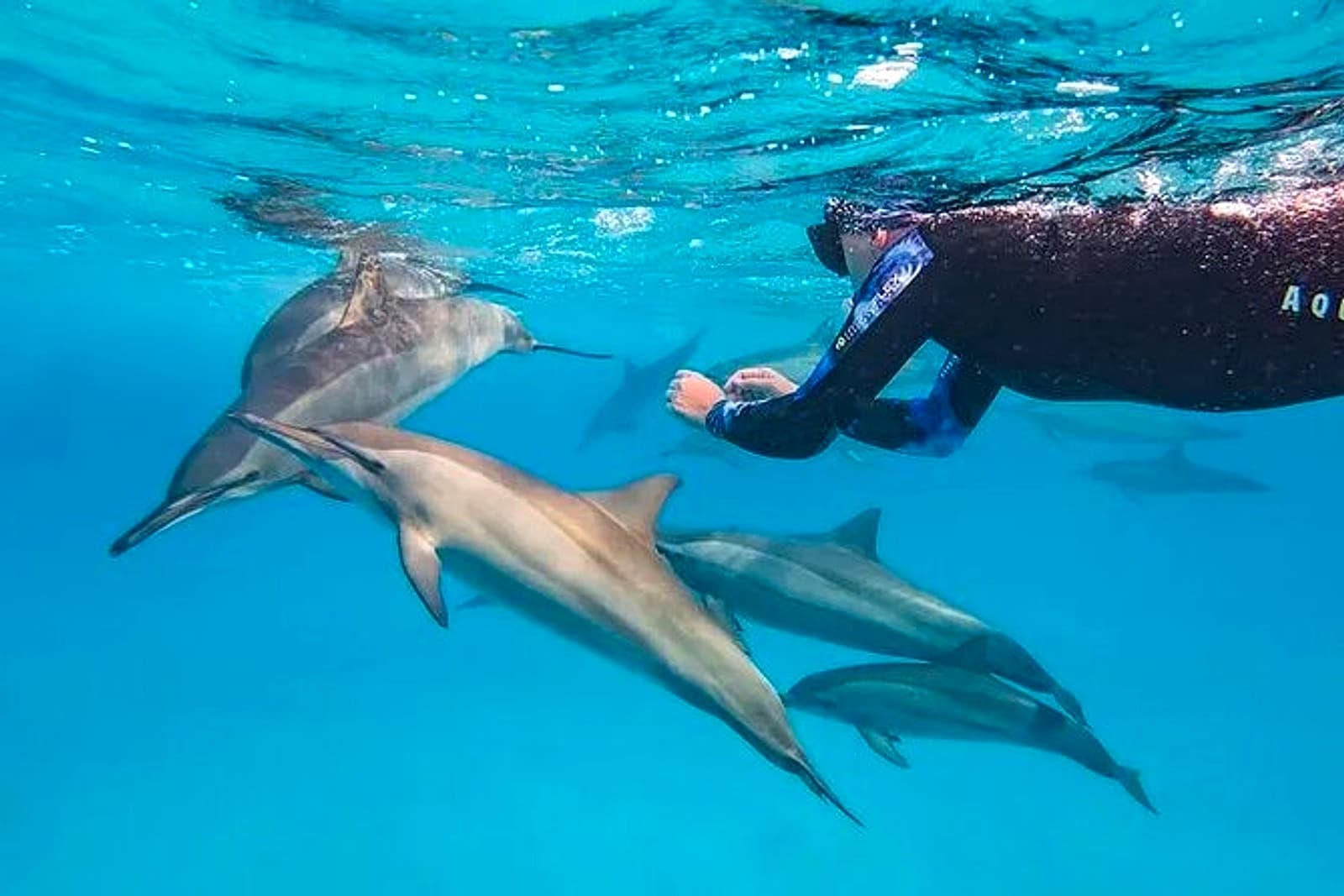
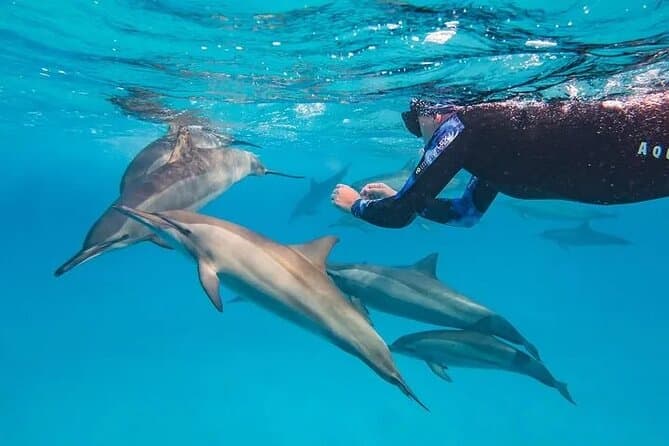
A good encounter usually means floating at the surface while a group of spinner dolphins passes below and alongside you, sometimes within a few metres, often in a loose line. They may circle back for a look. Calves swim tucked beside their mothers. It typically lasts minutes, not hours, and it is enough.
Some trips see the pod repeatedly through the morning. Some see them once, briefly. A minority do not see them at all, and any operator claiming otherwise is not being straight with you. The reef itself is spectacular either way — that is why the second snorkeling stop exists.
Rules that protect the encounter
These are not our preferences, they are the conditions that keep Samadai viable as a place where dolphins choose to be.
Do not touch, chase or attempt to swim into the middle of the pod. Do not block their path or dive down on top of them. Do not use flash photography. Stay with your guide and inside the permitted zone.
Use reef-safe sunscreen. Ordinary sunscreen damages coral, and at a protected reef like this the cumulative effect from hundreds of visitors a week is not trivial.
If a guide calls off an approach because the pod is settling or a calf is present, that is a good guide. It is the single clearest sign you booked with the right operator.
Frequently asked questions
What is the best month to see dolphins at Samadai Reef?
There is no single best month — the spinner dolphins are resident year-round. If you want the calmest seas and most comfortable conditions, April to June and October to November are the strongest windows. December to March has the highest chance of wind affecting the crossing.
Are dolphin sightings guaranteed at Dolphin House?
No. The dolphins are wild and use the lagoon on their own schedule. Sightings are frequent across a season but never certain on a given day, and any operator promising a guarantee is misleading you.
Is morning or afternoon better for seeing dolphins?
Morning, clearly. The pod typically moves into the sheltered lagoon to rest early in the day, before boat traffic and wind build up. This is why our trip departs with hotel pickup around 07:00–07:30.
Is Dolphin House the same as Samadai Reef?
Yes — Samadai Reef is nicknamed Dolphin House because of its resident spinner dolphin pod. Be aware that Sataya Reef further south is sometimes given the same nickname, so check which reef an operator actually visits before booking.
Can I swim with the dolphins at Samadai?
You snorkel in the permitted area of the lagoon while the dolphins move freely around it. You cannot swim into their core resting zone, touch them or chase them — Samadai is a protected area with enforced rules, and those rules are why the pod still uses it.
How far is Samadai Reef from Marsa Alam?
Roughly 15 km offshore, about 45 minutes by boat from the marina. With hotel transfers either side, expect a full day of around eight hours door to door.
Do I need to be a strong swimmer?
No. Life vests are provided and guides stay with the group throughout. You do need to be comfortable floating in open water off a boat — if that worries you, the sheltered Abu Dabbab bay trip is the gentler option.
What should I bring?
Reef-safe sunscreen, a towel, a hat and your swimsuit worn under your clothes. Snorkel gear, life vest, lunch and drinks are included. If you are prone to seasickness, take something before leaving your hotel rather than once you are aboard.
Dolphin House, Samadai Reef
From €59 / adult · 9 hours (approx.)