Marine life
Red Sea Marine Life at Marsa Alam: What You'll Actually See
· 9 min read · Lina Paoli, Marketing Manager
Near-certain: you'll see these on almost every trip
Reef fish generally. Marsa Alam's reefs support dense, healthy populations of small reef fish — damselfish, wrasse, anthias, and dozens of others moving in loose schools around the coral structure. You don't need luck for this; it's the baseline of any healthy reef here.
Parrotfish. Easy to identify by their beak-like fused teeth, used to scrape algae off coral — you can sometimes hear a faint crunching sound underwater as they feed. Common across all our trip sites and one of the more colorful fish you'll encounter, ranging from muted greens to vivid blues and pinks depending on species and age.
Butterflyfish. Small, flat-bodied, and usually patterned with bold stripes or eye-spots — the eye-spot near the tail is a genuine anti-predator adaptation, meant to confuse attackers about which end is the head. Typically seen in pairs and among the most reliably present fish on any of our reefs.
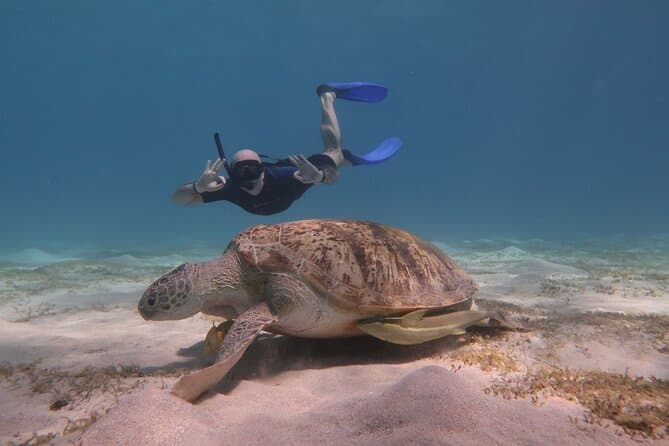
Green turtles at Abu Dabbab. Abu Dabbab Bay has a resident population of green turtles that feed on the seagrass beds close to shore, and sightings there are close to guaranteed — this is one of the most consistent wildlife encounters across all our trips. Behavior rule: keep a respectful distance and let the turtle continue feeding undisturbed; never block its path to the surface for air.
- Titan triggerfish can become territorial near nest sites on the sand — if one approaches with a fixed, direct swimming pattern, move away calmly
- Anthias form loose orange-and-purple clouds around coral heads; angelfish have tall laterally flattened profiles with bold vertical banding
Frequent: seen on most trips, not guaranteed every time
Spinner dolphins at Samadai and Sataya. Both reefs have resident pods that use the sheltered reef structure as a daytime resting site. Sightings are frequent — more days than not — but genuinely not guaranteed, since the pods move on their own schedule and aren't fed or called in by any operator. They're identifiable by their slender build and the acrobatic aerial spins that give the species its name.
Behavior rule: maintain distance, no touching, no chasing for a closer photo; let guides judge appropriate proximity on the day.
Occasional: a real possibility, not something to expect
Rays. Blue-spotted rays are the most commonly seen, usually resting partially buried in sand near reef edges; eagle rays occasionally pass in open water. Behavior rule: rays resting on the seabed are easily startled by close approach — keep a horizontal distance and never attempt to touch or lift one.
Moray eels. Usually seen partially emerged from a crevice in the reef rather than swimming in open water — their mouth-opening motion is a normal breathing behavior, not aggression, though it's often misread that way by first-time snorkelers. Behavior rule: don't reach into crevices or holes in the reef.
Napoleon wrasse. A large, distinctive fish with a prominent forehead hump, occasionally curious enough to approach snorkelers directly. Individually recognizable and long-lived — some encountered on Red Sea reefs are known to be decades old. Behavior rule: no feeding, even though some are habituated enough to approach.
Rare: possible, and worth genuine excitement if it happens
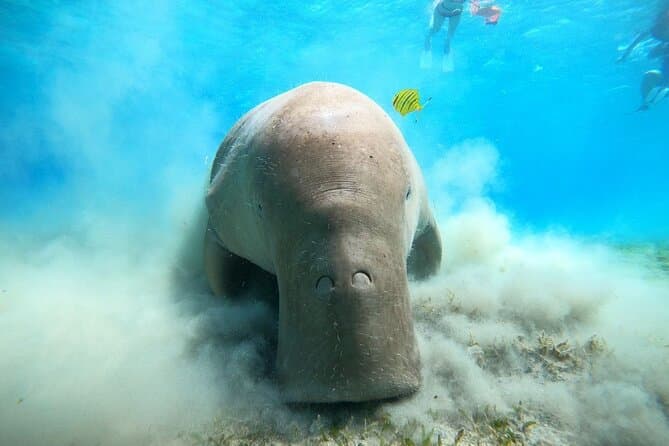
Dugongs at Abu Dabbab. This is Marsa Alam's signature rare encounter — a resident but small population that grazes on the bay's seagrass meadows. Dugongs are marine mammals, not fish, and surface periodically to breathe while continuing to graze along the seabed. Unlike the near-certain turtles sharing the same habitat, dugong sightings are inconsistent even for guests who visit multiple times.
Behavior rule: this is the strictest of any animal on our trips — no touching, no diving down to their level for a closer look or photo, and let guides manage distance entirely. A rare sighting is not an invitation to get as close as possible. See our dugong spotting etiquette guide for the full rules.
Very rare: seasonal possibilities, not something to plan a trip around
Whale sharks. Occasionally reported passing through deeper water off the Marsa Alam coast during their seasonal migration, most plausibly in spring. Despite the name, they're filter feeders and pose no danger — but a passing whale shark is also easily disturbed by a crowd of swimmers converging at once, so if one is spotted, stay with your guide's positioning rather than swimming directly at it.
Guests occasionally report manta rays or larger pelagic species passing in open water between reefs, generally on the boat crossing itself rather than at the snorkeling site. These sightings are opportunistic and brief — mentioned here for completeness rather than as something to anticipate.
Why we frame it this way
A guide organized by taxonomy tells a first-time visitor nothing useful about what to expect emotionally from the day. A guide organized by frequency does that job honestly: it tells you which animals are the reason to book (the near-certain reef life and turtles), which are the reason people come back (frequent dolphins), and which are the pleasant surprises you shouldn't count on (dugongs, whale sharks).
We'd rather set that expectation accurately than let a marketing photo of a dugong imply a frequency that isn't real.
Which trip gives you the best odds of each animal
If you're choosing a trip based on what you most want to see: Abu Dabbab is the strongest choice for near-certain turtle sightings and is also your only realistic shot at a dugong. Samadai and Sataya are both strong for dolphin encounters, with Samadai's shorter crossing making it the more accessible of the two.
None of our trips can be booked around whale shark sightings specifically — that possibility exists everywhere along this stretch of coast in season, but at a frequency too low to plan around.
A note on behavior rules
Across every category above, a few rules apply regardless of species: never touch, chase, or feed wild marine life; let guides set the pace and distance for any encounter; keep movements slow and deliberate near any animal rather than sudden; and treat a 'no sighting' day as a normal outcome for a wild reef, not a failure of the trip.
Marine life at Marsa Alam is wild and unmanaged in the sense that matters — nothing here is staged, fed into position, or guaranteed, and that's precisely what makes an actual sighting worth having.
Frequently asked questions
What am I most likely to see on any single trip?
Reef fish generally, and green turtles specifically at Abu Dabbab, are close to guaranteed. Everything else varies by trip and reef.
Are dugong sightings really that rare, or is that just caution talking?
Genuinely rare — even guests who've booked Abu Dabbab multiple times don't see one every time. We'd rather undersell this than oversell it.
Do you feed any of the animals to encourage sightings?
No, on any trip. Feeding wild marine life disrupts natural behavior and is something we actively avoid and discourage guests from doing themselves.
Is it safe to swim near moray eels or rays?
Yes, if you don't reach into crevices or attempt to touch resting rays. Both are only a genuine risk if provoked or handled.
Which trip gives the best chance of seeing dolphins?
Samadai and Sataya both have resident pods with frequent sightings; neither guarantees it. See our comparison of the two reefs for other differences beyond dolphin likelihood.
Have whale sharks ever been seen on one of your trips?
Very occasionally, and always as a chance encounter during their seasonal passage — not something factored into any trip's planning or marketing.
What should I do if an animal approaches me rather than the other way around?
Stay still and let it pass or move on its own terms — don't reach toward it, and follow your guide's instruction if they signal a distance to maintain.
Dugongs & Turtles, Abu Dabbab
From €60 / adult · 8 hours 30 minutes