Marine ethics
Is Swimming with Dolphins at Samadai Ethical? An Operator's Answer
· 10 min read · Lina Paoli, Marketing Manager
Why people are right to ask
'Swim with dolphins' has earned its skepticism. For decades, the phrase has also described captive dolphin shows, marine parks, and swim-with-dolphins pools where animals are bred or captured for entertainment, kept in enclosures far smaller than their natural range, and made to perform on a schedule for paying visitors. That industry has a well-documented record of animal welfare problems, and anyone who has read about it is right to bring that skepticism to any dolphin tourism offer, ours included.
The word 'wild' gets used loosely in tourism marketing generally, so it's fair to be suspicious of it here too. The only honest way to address that suspicion is to explain, specifically, what is and isn't true about Samadai — not to ask you to take our word for it.
Wild encounters vs. captive attractions: the actual difference
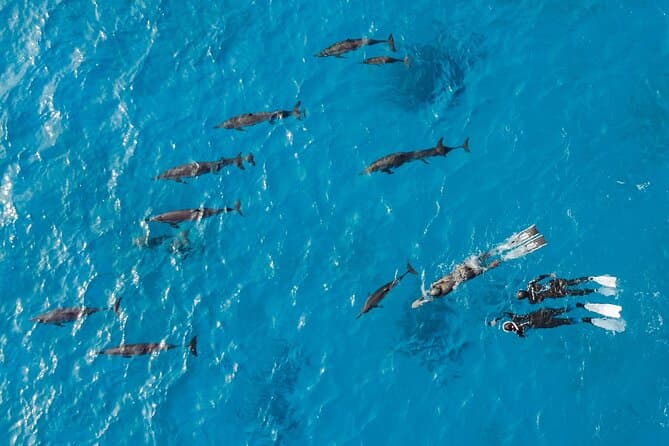
Samadai's spinner dolphins are not captive, bred, trained, or fed by anyone. They are a wild pod that uses the reef's sheltered lagoon as a daytime resting area — spinner dolphins hunt at night in deeper water and rest during the day in shallow, protected reefs, which is a well-documented natural behavior for the species, not something induced by tourism. Nobody at Samadai calls the dolphins in, feeds them to keep them present, or confines them in any way. They come and go on their own schedule, which is exactly why no operator, us included, can promise you'll see them on a given day.
That's the core distinction: a captive attraction controls the animal's presence and behavior. A wild-encounter site like Samadai controls human access to a place wild animals already choose to be. Those are different enough that lumping them under one ethical judgment doesn't hold up — but the second kind isn't automatically fine either, which is the harder part of this answer.
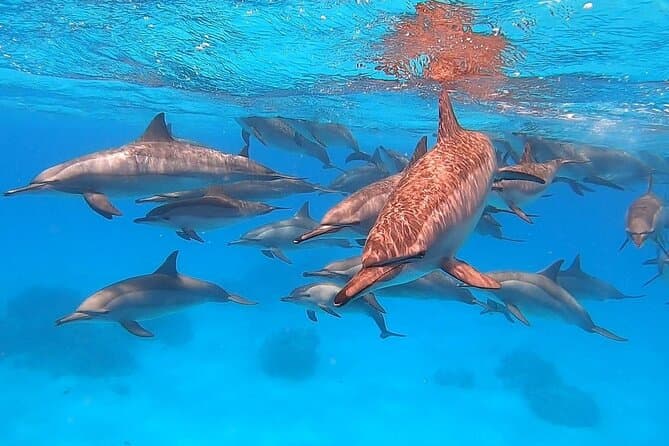
Spinner dolphins get their name from the acrobatic spins they perform at the surface, usually at dusk as they head out to feed — behavior you'll sometimes see even when the pod isn't approachable during the day. Their daytime resting pattern in sheltered, shallow reefs is a biological fact that is also the vulnerability tourism creates: a resting animal disturbed repeatedly during the day doesn't get to make up that rest at night, when it's busy hunting instead.
What ongoing monitoring can and can't tell you
Egyptian marine authorities and independent researchers have studied Samadai's pod behavior since the protected zone was established, largely to assess whether the zoning is working. The honest state of that evidence is mixed rather than conclusive: the pod has remained resident at the reef for two decades since protection began, which is a reasonable sign the site hasn't been abandoned due to disturbance, but 'the dolphins are still here' isn't the same as 'there is no ongoing stress.'
We're not aware of monitoring detailed enough to rule out chronic, low-level impact from repeated daily tourism. We'd rather tell you that the picture is incomplete than imply a level of certainty that doesn't exist.
How Samadai's protected-area zoning actually works
Samadai has been a legally protected marine area since 2004, managed under Egyptian environmental regulations specifically because of concern about dolphin-tourism impact. The protections are concrete, not symbolic: boats are required to moor at fixed mooring points rather than anchor freely on the reef, which prevents anchor damage to coral and limits how close vessels get to the resting pod. The number of swimmers permitted in the water at any time is capped. A core zone in the center of the reef, where the pod rests most consistently, has been closed to human entry entirely since the protection was established.
These rules exist because unmanaged tourism at Samadai in the years before 2004 was a real problem: crowding, harassment, and disturbance to the resting pod were documented and are part of why the protected status was created in the first place. The zoning is a response to a genuine past failure, not a marketing invention.
What responsible operators do differently
The zoning sets a floor, but operators vary in how they behave above that floor. Responsible practice means: keeping a respectful distance and letting guides — not guests — judge how close is appropriate on a given day; never chasing or repositioning a boat to close a gap for photos; keeping engine noise and boat movement to a minimum near the pod; briefing guests clearly, every time, on the rules before anyone enters the water; and being willing to call an encounter short, or skip it entirely, if the pod shows any sign of stress or if the reef is already at capacity with other boats.
We do these things, and so do several other operators at Samadai. Not all do, consistently, and there's no independent enforcement watching every boat every day — compliance depends significantly on operator judgment and guest behavior, backed by spot enforcement rather than constant supervision. For how Samadai compares to Sataya, see our Sataya vs Samadai comparison.
What tourists themselves do that causes harm
Operator behavior is only half of it. The most common problems we see are guest-driven: swimmers chasing dolphins to get closer for photos or video, ignoring guide instructions to hold position and let the pod approach on its own terms; touching or attempting to touch dolphins, which is against the rules and genuinely disturbs them; loud or sudden movement in the water; and simply too many people in the water at once relative to how much space the pod has to move through.
None of this requires bad intentions — it's usually excitement, not malice — but the impact on the animals doesn't care about intent.
The case against going at all
We said we'd be honest, so here it is without softening: even well-managed wildlife tourism has an impact. Every boat at Samadai, however carefully it's operated, adds engine noise and human presence to a resting area that would otherwise be undisturbed. The cumulative effect of tourism — even zoned, capped, rule-following tourism — is not zero, and there's a legitimate conservation argument that the most protective thing for the pod would be less human traffic at Samadai, not better-managed human traffic.
Some conservation-minded travelers reasonably conclude that the right choice is not to go, and we don't think that position is unreasonable or uninformed. If you land there after reading this, we'd rather you make that decision with accurate information than skip it based on a fear of something — captive dolphin shows — that this specific trip genuinely isn't.
What a visitor can do to minimize their impact
If you do go: follow your guide's instructions without exception, especially about distance and not touching; don't ask your guide to get closer for a better photo; keep noise and splashing to a minimum; accept that some days you won't see the pod at all, and don't push to search for them beyond the guide's judgment; and choose an operator who's willing to tell you honestly that sightings aren't guaranteed, rather than one who implies otherwise to close the sale.
It's also worth asking, before you book with anyone, how they handle a day when the reef is already crowded with other boats. A responsible operator will sometimes choose to hold back, shorten the water time, or reposition rather than add another boat's worth of pressure to an already full site. If an operator can't or won't answer that question, that tells you something about how they'll behave on the water when no one's checking.
Frequently asked questions
Is Samadai a captive dolphin attraction?
No. The dolphins are wild, free-ranging, and not fed, bred, or confined by anyone. They use the reef as a natural daytime resting site.
Can you guarantee we'll see dolphins?
No, and any operator who guarantees it is being dishonest with you. The pod moves on its own schedule; sightings are frequent but not certain.
Are dolphins ever touched or fed during the trip?
Touching is against the protected-area rules and against our own briefing to guests. We don't feed the pod, and feeding wild dolphins disrupts their natural hunting behavior.
Who enforces the rules at Samadai?
Egyptian environmental authorities established and oversee the protected-area status. Day-to-day compliance also depends heavily on individual operators and guides, and enforcement is spot-based rather than constant.
Is it better to skip Samadai entirely for conservation reasons?
That's a legitimate position, and we say so above without qualification. If minimizing your tourism footprint on this pod matters most to you, not going is a valid choice.
How is this different from a dolphinarium or swim-with-dolphins pool?
Those facilities hold captive-bred or captured animals in enclosures, often trained to perform. Samadai's pod is wild, unconfined, and free to leave the area at any time — which some days, they do.
Does the boat ever chase the dolphins to find them?
No. If the pod isn't at the reef, or has moved beyond where guests can safely and respectfully enter the water, we don't pursue them further.
Why are you publishing an article that might talk people out of booking?
Because we'd rather lose a booking from someone who decides, with full information, that this isn't for them, than get a booking — or a bad review — from someone who felt misled afterward. We have a commercial interest in this trip, and we think being honest about its limits is the only credible way to sell it at all.
Dolphin House, Samadai Reef
From €59 / adult · 9 hours (approx.)