Family guide
Marsa Alam with Kids: Which Snorkeling Trips Actually Work
· 8 min read · Lina Paoli, Marketing Manager
The short version
Abu Dabbab is the family trip. It's a beach entry — no boat crossing, no getting in and out of a moving vessel — with shallow, calm water and a long but flexible day (roughly 8–9 hours) that doesn't force kids into hours of continuous water time. Adult price is EUR 60, child EUR 45.
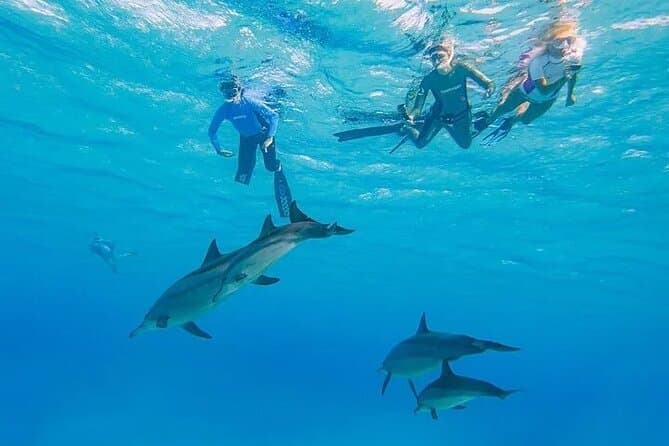
Samadai can work for confident older children, roughly ages 8 and up who are already comfortable swimmers and have snorkeled before. It involves a real boat crossing (about 45 minutes each way) and a full 8-hour day. Adult price is EUR 55, child EUR 45.
Sataya is not a good fit for young children, and we'll say that plainly rather than let you find out on the day. The near-10-hour day, including a 2-hour drive each way before the boat even leaves the dock, is a long haul for an adult and a genuinely bad idea for a young child. We'd rather lose this booking than watch a 6-year-old melt down four hours into a trip with no way to leave early. For a full breakdown of how Samadai and Sataya differ, see our Samadai vs Sataya comparison.
Realistic minimum ages
There's no single 'minimum age' that applies across all three trips, because the limiting factor isn't the child's age on paper — it's water confidence, patience for a long day, and how they handle being somewhere they can't simply walk away from if they're done. That said, as rough guidance: Abu Dabbab's beach entry works for most kids from around age 5 up, provided they're comfortable in water and can wear a mask without distress. Samadai's boat trip is a better fit from around 8 up, and mainly for kids who've snorkeled before and enjoyed it, not as a first introduction. Sataya's long day is realistically an option for older children and teenagers who already handle full boat days well — not a trip we'd recommend for anyone under about 12.
These are starting points, not rules. We've had confident 6-year-olds handle Samadai fine, and we've had reluctant 10-year-olds who were miserable on it. You know your child's tolerance for a long day better than any age guideline does.
If you're not sure which category your child falls into, a useful test is how they've handled other long, structured outings — a full day at a theme park, a long flight, a multi-hour hike. A child who does fine with those tends to do fine on a boat day too. A child who struggles with long days regardless of the activity will likely struggle here as well.
What 'child-friendly' actually means on a boat
It's worth being specific here, because 'family-friendly' gets used loosely in tour marketing. On our boats, it means: life vests sized for children, not just adults sized down; a guide briefing that's paced for a child's attention span rather than rushed through; the ability to sit out a rotation without pressure if a child isn't feeling it that day; and shade and a place to rest that isn't just 'the same bench everyone else is on.'
It does not mean the water gets shallower, the crossing gets shorter, or the day gets less structured around adult snorkelers' pace — those are fixed by the trip itself, which is exactly why trip choice matters more than which operator you book with.
Life vests and gear sizing
Ill-fitting gear is the single most common reason a child has a bad time snorkeling, more than the water or the wildlife. A mask that leaks constantly, fins that slip off, or a life vest that rides up under the chin will make any child anxious regardless of how calm the reef is. We size vests and gear for children specifically rather than handing out adult equipment a size down, but if your child has a mask they already know fits well and like using, bring it — familiar gear removes one more unknown from an already new experience.
Managing a long day
Even Abu Dabbab's more flexible schedule is still most of a day. Build in expectations accordingly: bring snacks beyond what's provided, plan for a child who wants to nap mid-afternoon, and don't schedule anything demanding for the evening after a boat or beach day — sun and water are more tiring for kids than parents often expect, even when the child seems fine in the moment.
For Samadai specifically, the 45-minute crossing each way means roughly 90 minutes of boat time that isn't snorkeling at all; bring something to keep a child occupied during the crossing itself, not just for the water portions.
Seasickness in children
Children are, on average, more prone to motion sickness than adults, and a boat crossing is often the first time a child encounters it. If your child has never been on a boat before, Samadai's 45-minute crossing is a reasonable low-stakes test — uncomfortable if it goes wrong, but short. Sataya's longer transit is a much bigger risk for the same reason.
Simple precautions help: a light meal rather than an empty or overfull stomach before departure, a seat with a view of the horizon rather than facing sideways or down, and any motion-sickness remedy your child's doctor has already approved for their age, taken before departure rather than after symptoms start.
What to pack for kids specifically
Beyond the standard sunscreen and water, families tend to underpack for: a rash guard or swim shirt (children burn faster than adults and reapplying sunscreen mid-trip is unreliable), a dry change of clothes for the ride home, snacks that don't need refrigeration, and any comfort item that helps a child settle during downtime on the boat or beach.
A hat that stays on in wind or water is worth the extra few minutes finding one that fits securely — most don't, and a child chasing a hat in the water is a genuine hazard, not just an inconvenience.
When to skip the boat entirely
If your child is under 5, has never been in open water, gets seasick easily, or simply doesn't enjoy long unstructured days, the honest answer is to skip the boat trips this visit and consider Abu Dabbab's beach entry instead — or, if even that feels like a stretch, to wait for an older, more water-confident age before booking any snorkeling trip at all.
A bad first experience with snorkeling as a young child can put them off the activity for years; there's no prize for pushing a reluctant 4-year-old through a boat day before they're ready, and the reef will still be there when they are.
Frequently asked questions
What's the youngest age you'd recommend for any of these trips?
Around 5, and only for Abu Dabbab's beach entry. We wouldn't recommend a boat trip for a child younger than about 8, and even that depends heavily on the individual child.
Do you provide child-sized snorkeling gear?
Yes, masks, fins, and life vests are available in children's sizes across all three trips.
Is Abu Dabbab actually shallow enough for a nervous swimmer?
Yes — it's a beach entry with a gradual depth increase, so a child (or adult) can stand in parts of it and wade out at their own pace rather than being dropped into deep water from a boat.
Can my child sit out part of the trip if they don't want to snorkel?
Yes, on all three trips. Nobody is required to get in the water, and there's always a place to rest on board or on the beach.
What if my child gets seasick on the way out to Samadai?
Let your guide know immediately — they can reposition seating, and in more serious cases the trip can adjust plans. It's far better to say something early than to wait it out.
Is Sataya ever appropriate for a family with kids?
For teenagers who are experienced with long boat days, potentially yes. For children under about 12, we'd steer you toward Abu Dabbab or Samadai instead, and say so directly rather than take the booking.
Do you offer a shorter version of any trip for families with young kids?
Not as a fixed product, but talk to us directly if a full day feels like too much — we'd rather adjust expectations up front than have a family cut a trip short partway through.
Dugongs & Turtles, Abu Dabbab
From €60 / adult · 8 hours 30 minutes